A well-designed casual game economy operates much like a finely tuned engine. Beneath simple mechanics like tapping targets, clearing levels, or harvesting crops lies a series of interlocking currency loops designed to keep players engaged, moving forward, and continuously returning for more.
The core loop: Earn, burn, repeat
At the heart of almost every casual or idle title is the fundamental feedback loop. It relies on a straightforward sequence that turns basic player actions into tangible progression:
- Earn: The player engages in the primary gameplay action and receives a basic reward, usually a high-volume soft currency like coins or gold.
- Burn: The player spends these accumulated coins on linear upgrades—increasing production speed, expanding storage capacity, or boosting output stats.
- Scale: Upgraded stats allow the player to clear content faster and earn coins at an accelerated rate. To maintain momentum, the cost of subsequent upgrades scales exponentially alongside earnings.
Depth: Soft vs hard currencies
A single-currency loop eventually encounters a wall. Without secondary layers, numerical inflation sets in, upgrade costs become absurdly large, and player fatigue takes over. Introducing a second, harder currency adds strategic depth and restores control over pacing.
| Currency Type | Primary Purpose | Acquisition & Behaviour |
| Soft Currency
(Coins, Gold, Cash) |
Drives daily operational upgrades, small stat boosts, and routine progress. | High-volume, constantly flowing, earned through standard gameplay. Provides instant gratification. |
| Hard Currency
(Gems, Tokens, Diamonds) |
Unlocks premium perks, permanent stat multipliers, time skips, and automation. | Scarce, highly controlled. Awarded via major achievements, daily logins, or special events. |
By keeping these two currencies separate, the game prevents players from simply grinding basic tasks to unlock high-value progression gates, preserving long-term goals.
Real-world currency injection: Trading money for time
In-app purchases (IAP) function as a variable accelerator injected directly into this economic loop. At its core, game economy design balances two primary player resources: time and money.
Real-world currency allows players to fast-forward their trajectory through the economy via three main mechanisms:
- Direct Hard Currency Purchases: Buying gems or tokens instantly bypasses long wait timers or unlocks high-tier boosts without waiting for achievement payouts.
- Resource Bundles: Large injections of soft currency allow players to jump straight over high upgrade thresholds, skipping hours or days of routine grinding.
- Income Multipliers: Purchasing permanent or timed percentage boosts to overall earning rates permanently speeds up every future loop around the economy.
Stopping collapse: Dynamic sinks and expanding loops
If a player maxes out their stats or accumulates a surplus of soft currency, the economy risks collapsing. To keep the cycle going indefinitely, game designers rely on dynamic sinks and expanding loops:
Dynamic sinks and prestige systems
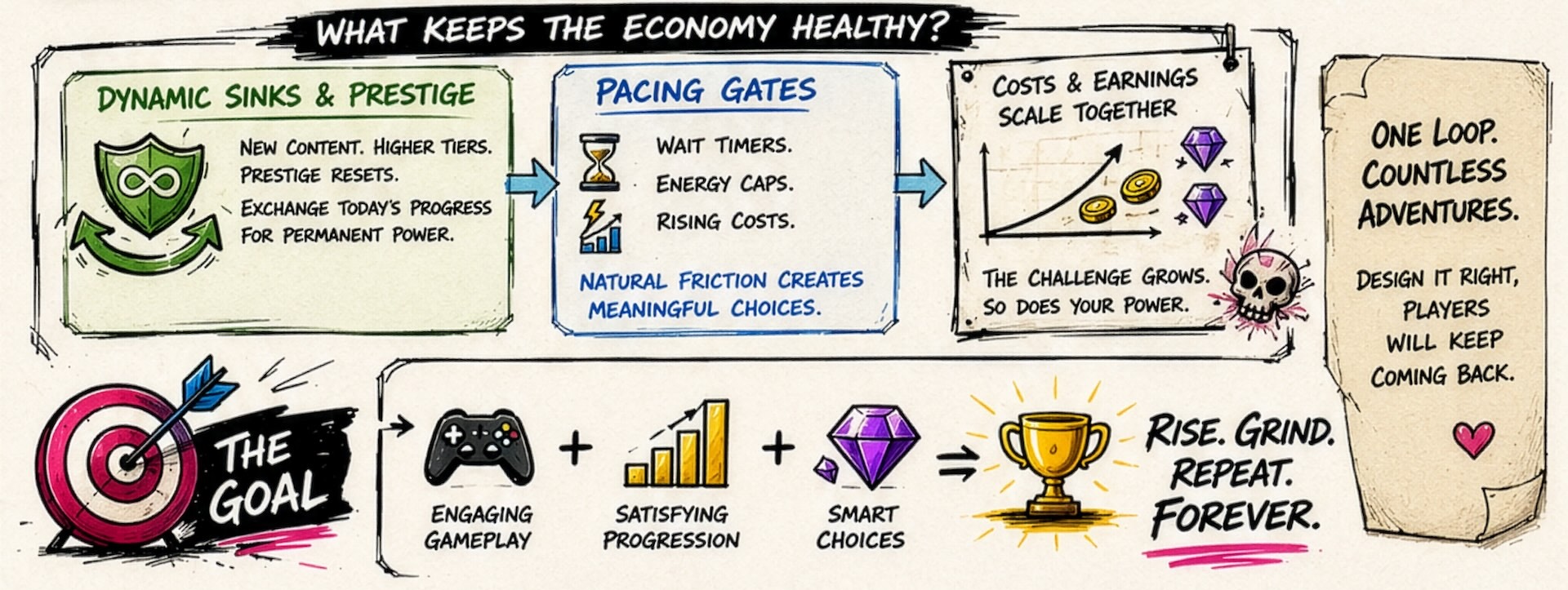
New content updates introduce higher upgrade tiers, new territories, or reset mechanics (often framed as “Prestige” or “Rebirth”). These systems wipe a player’s accumulated soft currency in exchange for permanent, high-level percentage boosts that make subsequent loops significantly faster.
Pacing gates
Wait timers, energy caps, and steep exponential price curves naturally decelerate soft currency accumulation over time. This soft slowdown creates a comfortable choice point, gently nudging the player toward using hard currency or making an in-app purchase to maintain their current momentum.
Summary strategy
The interplay between soft grinding, hard currency milestone tracking, and paid acceleration creates a sustainable, balanced sense of achievement. When structured correctly, it builds a rewarding “Rise & Grind” rhythm that keeps players engaged for the long haul.
